
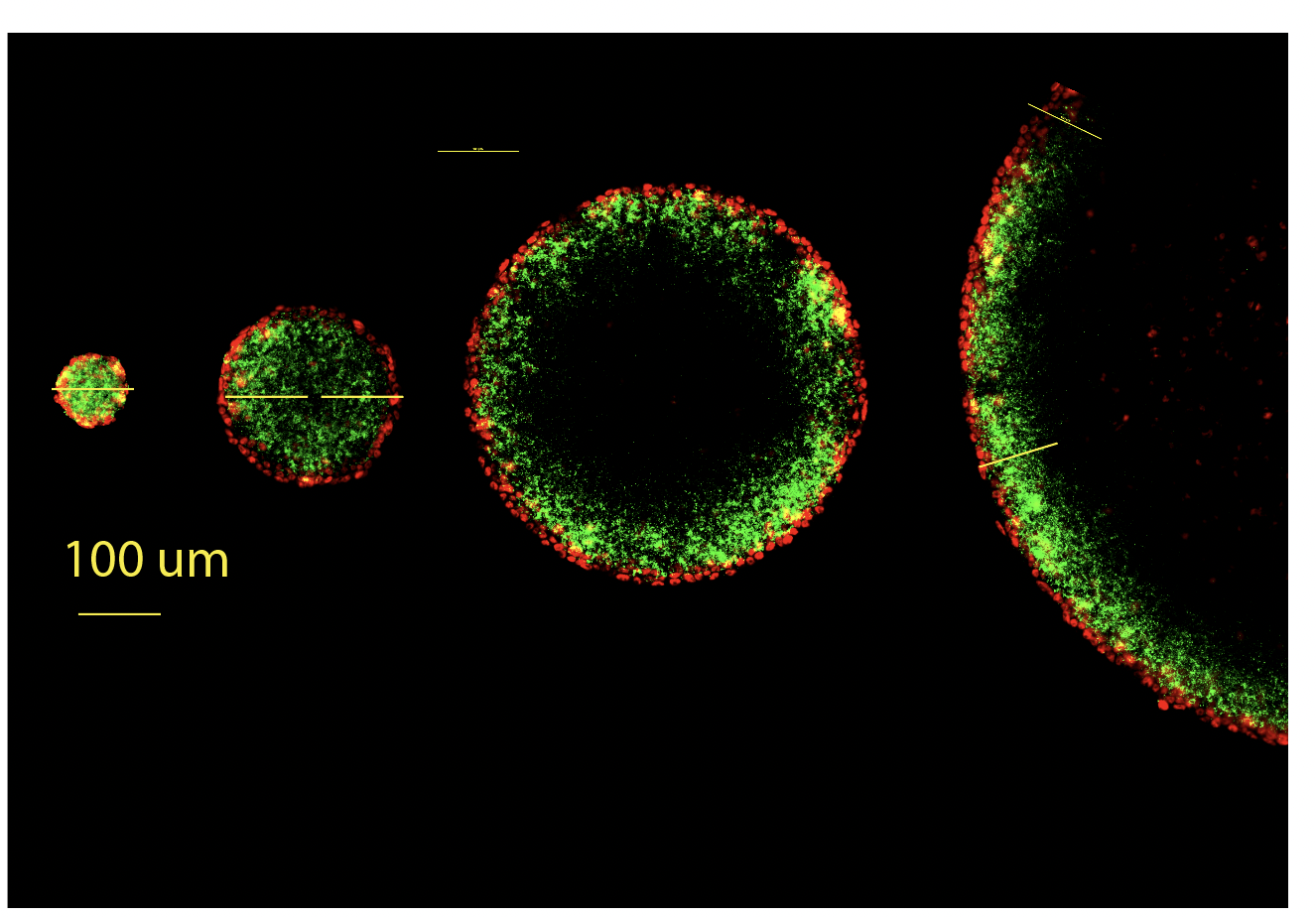
Spontaneous pattern generation across human ESCs grown in circular culture for 72 hours. Nanog 3’UTR (red) and coding region (CDS) (green) mRNA expression.
Lab Focus
Messenger RNAs (mRNAs) contain both coding sequences (CDS) and untranslated regions (UTRs), with biological function most often ascribed to the encoded protein. However, we and others have shown that 3’UTRs and their cognate CDSs can be differentially expressed across tissues and developmental contexts, forming striking and often reciprocal spatial pattens of expression (Mercer, Wilhelm et al. 2011, Kocabas, Duarte et al. 2015, Malka, Steiman-Shimony et al. 2017, Ji, Yang et al. 2021, Yang et al. 2026). As a result, many cells harbor abundant, stable, mRNA derived noncoding 3’UTR fragments (Malka, Alkan et al. 2022), raising the possibility that such 3’UTR RNA components may carry biological functions beyond regulating transcript stability or localization.
Our findings demonstrate that differential mRNA component expression at the Nanog locus encodes distinct and separable regulatory function, revealing mRNA domain usage as a distinct regulatory layer through which genes can encode multiple biological outputs beyond protein coding capacity.
Our initial studies raised a number of questions, most importantly how such isolated 3'UTRs species arise and secondly whether they play important or critical biological roles. Our lab focuses on the biological role of isolated 3'UTRs using three model paradigms (i) embryonic stem cells (ii) cancer cells iii) neural differentiation (dopamine, cortical neurons and peripheral sensory neurons).
Yang, Z., Ji, S., Ivanov, K., Kadav, P., Song, M-M., Gozali, L., Parsa, S., Behr, B., Hynes, M. (2026). Functional separation of mRNA domains coordinates pluirpotent cell behavior. Elife. https://doi.org/10.7554/eLife.110994.
Ji, S., Yang, Z., Gozali, L., Kenney, T., Kocabas, A., Park, C.J., Hynes, M. (2021) Distinct expression of select and transcriptome-wide isolated 3’UTRs suggests critical roles in development and transition states. PLoS One 16 (5).
Kocabas, A., Duarte, T., Kumar, S. & Hynes, M. A. (2015) Widespread Differential Expression of Coding Region and 3' UTR Sequences in Neurons and Other Tissues. Neuron 88, 1149-1156, doi:10.1016/j.neuron.2015.10.048.
Mercer, T. R. et al. Expression of distinct RNAs from 3' untranslated regions. Nucleic Acids Res 39,2393-2403, doi:10.1093/nar/gkq1158 (2011).
Malka, Y. et al. Post-transcriptional 3 -UTR cleavage of mRNA transcripts generates thousands of stable uncapped autonomous RNA fragments. Nat Commun 8, 2029, doi:10.1038/s41467-017-02099-7 (2017).
Possible biological roles of i3UTRs
i3'UTRS are essentially long non-coding RNAs (lncRNAs) as they are >200bp and in general do not code for protein. They may, therefore, carry out any of the known functions of lncRNAs such the spatial and temporal regulation of gene expression (as in Chao and Vogel, 2016; summarized at right), the regulation of cellular, developmental or disease-related events, or the shuttling of protein coding mRNA to specific targets. Each of these will be considered in our models.
